

Every November, South Korea grinds to a halt for its notorious college entrance exam.
Stores close, air travel is postponed to reduce noise, and even the rhythm of the morning commute slows down for the students.
By late afternoon, the majority of examinees exit of examination centers, exhaling with relief and greeting the relatives standing by.
However, some individuals finishes at that time. After night has fallen and night has set in, certain test-takers are still in the exam room – finishing close to 10pm.
They are the blind students, who frequently spend more than 12 hours completing the most extended form of the Suneung.
The Marathon Examination
On Thursday, over 550,000 students across the country will sit for the CSAT – a shortened form for College Scholastic Ability Test in Korean. This represents the largest figure of test-takers in seven years.
The test doesn't just determine if students will be able to go to university, but can affect their career opportunities, earnings, future residence and even personal connections.
Depending on their subject choices, students answer roughly 200 questions across language, math, English, science subjects, second language, and Chinese characters.
For most students, this constitutes an full-day endurance test of back-to-back exams. They begin the examination at 8:40 AM and conclude around 5:40 PM.
Visually impaired test-takers with significant sight challenges, however, are allocated 1.7 times the regular exam time.
This means, if they take the optional language section, the exam can end as late as 9:48 PM – nearly thirteen hours after it started.
There is no evening meal; the exam continues straight through.
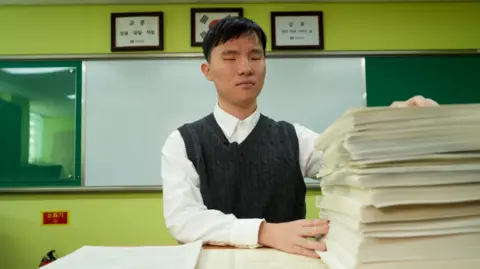
The physical bulk of the braille test papers also contributes to the length.
As each phrase, symbol and chart is converted into braille, every exam document becomes significantly thicker than the regular version.
Student Perspectives
At Seoul Hanbit School for the Blind, 18-year-old Han Donghyun is one of the students who are preparing for the longest version of the exam currently.
Previously, there were over a hundred blind test-takers across the country – ninety-nine with low vision and 12 with severe visual impairments like the student – according to information from educational authorities.
Dong-hyun was visually impaired from birth and cannot distinguish light.
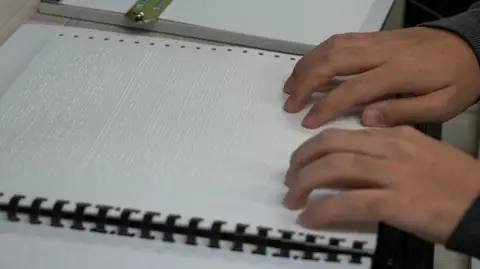
When meeting on campus, his fingers moved quickly across a braille practice booklet of past exam questions.
Approaching the examination date, he was focused on managing his endurance and physical state. He will take the exam using braille test papers and a audio assistance device.
"The fatigue is significant because the test duration is extensive," he mentioned. "But there's no special trick. I just follow my study schedule and try to manage my condition. That's the only way."
The student explained the Korean language section is especially challenging for him.
Regular examination materials for this part is approximately 16 pages – but the braille version is about 100 pages long.
Despite using screen-reading software, verbal content vanishes as immediately after it is perceived, contrary to written content that can be seen and re-read. Dong-hyun has to retain information in his recall as he progresses.
Math component is equally demanding.
He needs to comprehend complex graphs and data sets that have been converted into tactile format, using only his touch.
Nevertheless, he observed that conditions have improved than they were previously. In the past, examinees had to do nearly every calculations in their heads. However, recently, visually impaired students have been permitted to use a braille notetaker, known as the assistive tool.
"Similar to sighted students document their work in pencil, we input them in braille on the device to follow the steps," he explained.

Physical Demands
Another student at the institution, 18-year-old a test-taker, who will likewise complete the exam this year, said the late afternoon are "the hardest point" of the day.
"Up until lunch, it's tolerable," he stated. "However, during late afternoon, following language sections and prior to history, that period the challenge intensifies.
"Without an evening meal," he explained. "We continue answering questions while we would typically dine, so it feels even more exhausting. Nevertheless, I persist because I understand there will be a sense of accomplishment at the end."
For the student, the fatigue is intensified by the need to stay highly concentrated with tactile input and his auditory perception.
"When I'm reading the braille with my fingers and also taking in content through audio, it seems much more tiring than it does for sighted students," he described.
Accessibility Barriers
However, examinees say that the test duration and the long study hours are not the hardest part. The main difficulty is availability of learning resources.
Common educational materials and digital classes that those with vision rely on are often out of reach.
Limited numbers of braille versions, and converting materials into sound needs having text files – which are hard to acquire. In many cases, individuals must manually type entire workbooks to create accessibility.
Online lectures present additional challenges, as many instructors present information using visual notes, illustrations and images on screen, which cannot be followed through sound only.
A major obstacle, however, is the delay in obtaining braille versions of the state-produced EBS preparation books – a essential collection of materials closely linked to the national exam.
Due to this postponement, visually impaired examinees frequently obtain the materials with significant delay than others.
"Sighted students receive materials between January and March and use them for the entire period," explained the student. "We receive the braille files approximately in August or September, when the exam is approaching quickly."
The student shared the same concern.
"The braille materials weren't ready until under three months prior to testing," he said. "I consistently hoped the production timeline could be faster."
The National Institute of Special Education, which creates the braille version of EBS exam materials, explained that the process requires minimum three months for each book because it must follow relevant guidelines.
The organization added that it is "implementing multiple initiatives to ensure that blind students can learn uninterrupted, including creating and providing the materials in individual sections."
The Korean Blind Union indicated it has long raised this issue with {author


